
December 2025: a Content Hub breaking change, and a rename nobody at Sitecore explained
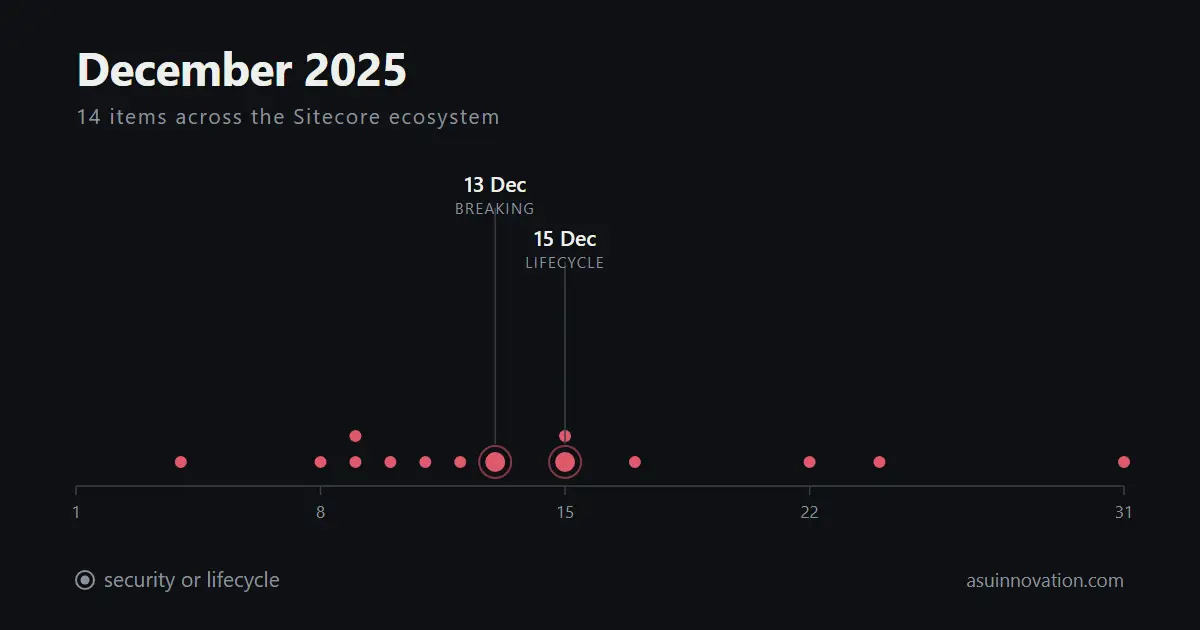
If you deploy Sitecore Content Hub through a CI/CD pipeline, December 2025 is the month that pipeline stopped being safe. The new package import/export engine is now the default in both the UI and the CLI, and the package structure underneath it changed shape.
That is the only item in the month's Sitecore harvest that forces work this week. The rest of December was the community doing a job the vendor left open: explaining what SitecoreAI actually is, six weeks after the XM Cloud brand was retired. Of the thirteen posts cited below, not one comes from sitecore.com.
Content Hub packages are grouped by resource type now, and your pipeline doesn't know that
The new import/export engine is now the default — 360Agileweb.dev; the page carries no individual byline, only the site's own name
The post is a folder-by-folder comparison of an old export package against a new one, and the
diff is the whole story. Copy profiles, export profiles, media processing sets, rendition links,
settings, triggers and scripts all land under entities now. Option lists move to datasources.
Anything in your release automation that reaches for policies/ or portal_pages/ by path is
reaching for a folder that no longer holds what it used to.
The author's warning is blunt: "there is a high risk of breaking your environments if you try use existing CICD pipelines without refactoring". Two things are also newly exportable, publish definition configurations and email templates, with email templates unchecked by default.
This is a breaking-change and cut-over-date claim and we only have a community source for it. The
post links the Sitecore Support notification and the developers.sitecore.com changelog entry.
Read those before you refactor anything.
Six posts about SitecoreAI, none of them from Sitecore
Intro to SitecoreAI — Theresa Gutierrez, Fishtank Consulting The most complete explainer of the month, and the one that needs the loudest label: Fishtank implement Sitecore commercially and the piece ends in a contact-our-experts call to action. Her framing is that "SitecoreAI is not a rebrand" but "a complete rebuild of the platform". The post also makes specific licensing claims about what the base tier now includes and how AI is metered. We have no vendor-official source for any of that. Treat it as a list of questions to put to your account team in writing, not as a fact to build a 2026 budget on.
Track SitecoreAI updates — Filip Jönsson, Sitecore Tackled The opposite approach and a more useful habit: subscribe to the changelog RSS. He then summarises what he found there, including Blok reaching general availability and Page Builder deletions going to the recycle bin instead of disappearing outright. The underlying release notes are official; his summary is not, so click through before you quote a date.
A Sitecore Connect push webhook into Sitecore AI — Ben Sewards, Tech Appetite A working recipe that pushes third-party items into a bucket for authoring use. Step four says more about the state of the rename than any explainer: in Connect, the app you select is still called "Sitecore XM Cloud".
Getting started with Sitecore Blok — Gabriel Baldeon, Sitecore Center Blok in a Next.js app, React plus Tailwind through the ShadCN approach, including the Blok MCP server so Copilot can generate components against the design system.
From XM Cloud to SitecoreAI CMS — Robbert Hock The new learning paths and Credly badges, read by someone who has certified on the old ones. Hock works with the platform as a freelance consultant, so this is a practitioner's account of Sitecore's curriculum rather than a neutral review of it.
The unglamorous half is where the reusable knowledge is
Adding custom Solr indexes in SolrCloud — Kelly Rusk, thebitsthatbyte.com Two and a half thousand words on standing up a custom blog index on Windows Server, with the configset and collection scripts. Our harvest recorded the author as "Name *", which is a scraped form label rather than a byline; the scripts published in the post are signed "Author: Kelly Rusk", so that is the credit.
Excluding paths in Sitecore Content Serialization
— Marcel Gruber, MG on SC
Two hundred lines that stop SXA's generated thumbnails and sitemaps from being serialised, via the
rules array and "scope": "ignored". Gruber is honest about why he wrote it: "Claude kept
getting it wrong, and finding a good example in the Sitecore docs took longer than it should
have." Our record had no byline for this page; the site's own strapline names him.
Tracking iframe clicks with GTM and GA4 — Manoj Chopkar, Sitecore help house A card navigation living inside an iframe was reporting zero engagement to leadership. The fix is entirely in Tag Manager with no Sitecore redeploy, which is the constraint that makes it worth reading.
Converting a Sitecore Forms email body to valid JSON — Navan, Navan Sitecore Notes Migrating Sitecore 10 Forms send-email parameters to XM Cloud throws a bad-control-character parse error in the browser console, because quotes and apostrophes in the HTML body were never escaped. Two short PowerShell scripts, one afternoon saved.
Migrating an enterprise Sitecore project to App Router
— jeroenbreuer.nl; the article page carries no byline, the site is Jeroen Breuer's personal blog
A POC branch off a real production project on Content SDK 1.1, moving navigation and footer from
getComponentServerProps to async server components. The reason to read it is that he says
"demos only prove concepts" and then goes and does it on something with dozens of components. He
describes App Router support in the Content SDK as still in beta; that is his account, not a
vendor statement.
Two bets on what comes after the page
The next CMS isn't just about content, it's about context — Boris Brodsky Short and arguable, which is what makes it worth the four minutes. Brodsky's case is that "the next generation of CMS needs to do more than present content. It needs to understand it", and that the mechanism is ontology rather than richer content types. You can disagree with where he lands and still take the question seriously.
An unofficial Figma MCP server — the post carries no byline and is written in the first person plural on exdst.com, Anton Tishchenko's site Figma's own MCP server is read-only. This one writes: it creates components, auto layouts and forms from prompts. The same team had already wired Figma into Sitecore component generation, so the write path closes a loop they were missing rather than being a novelty.
What we'd do in January
The absence worth naming is Sitecore's. The company retired the XM Cloud brand in November and then spent December letting a partner agency, a design-system tutorial and a handful of personal blogs carry the explanation. That is not a thriving community, it is an unpaid documentation team, and it has a concrete cost. When the only written account of what your licence now covers ends in a sales call to action, you cannot take it into a renewal conversation.
So, two things. Run the Content Hub package diff against a non-production environment before you touch a release pipeline, because the change is already the default and discovering it at deploy time is the expensive route. And send the licensing questions to your account team in writing before anyone plans a 2026 budget on a blog post, however good the blog post is.
Sources
- Sitecore Content Hub DevOps: New Import/Export engine with breaking changes is now default — 360Agileweb.dev, no individual byline on the page
- Track SitecoreAI Updates: Changelog Insights — Filip Jönsson, Sitecore Tackled
- Intro to SitecoreAI: The Future of the Sitecore Platform Explained — Theresa Gutierrez, Fishtank Consulting
- Creating a Sitecore Connect Push Webhook Recipe to Sitecore AI — Ben Sewards, Tech Appetite
- Getting Started with Sitecore Blok: Building a Next.js App with AI Assistance — Gabriel Baldeon, Sitecore Center
- From XM Cloud to SitecoreAI CMS: Continuing the Learning Journey — Robbert Hock
- How to Add Custom Solr Indexes in SolrCloud — Kelly Rusk, thebitsthatbyte.com
- How to Exclude Paths in Sitecore Content Serialization — Marcel Gruber, MG on SC
- How to Track Iframe Clicks in Sitecore Using GTM + GA4 — Manoj Chopkar, Sitecore help house
- Convert Sitecore Form Email Body to valid JSON — Navan, Navan Sitecore Notes
- Migrating an enterprise Sitecore project to App Router — jeroenbreuer.nl, no byline on the page
- The Next CMS Isn't Just About Content - It's About Context — Boris Brodsky
- Figma MCP Server — exdst.com, no byline on the page