
January 2025: twelve field reports and nothing from the vendor
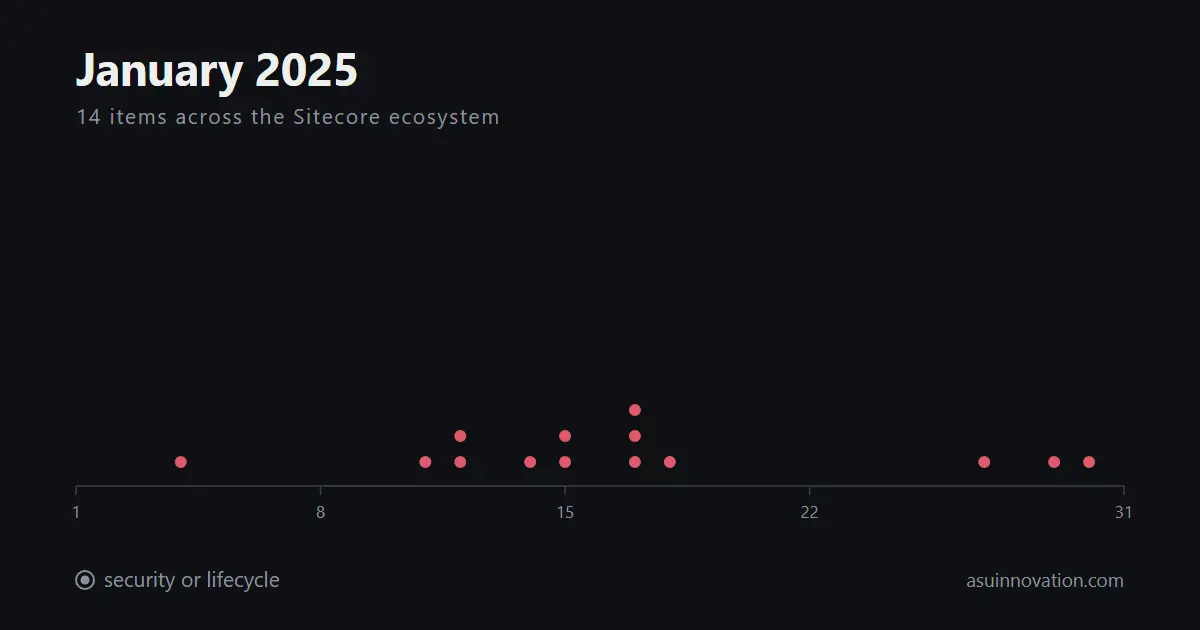
Nothing in this month's Sitecore source list came from Sitecore. Fourteen items reached the list, twelve of them are below, and every one is somebody's personal blog or their employer's.
Read that absence carefully, because it is partly ours. This window was reached through feed archives rather than harvested live, so what it proves is that nothing from sitecore.com survived into the archives we could get to, not that the company published nothing in January 2025. The harvest returned 28 items for the month, 22 of them Sitecore, and 14 made this post's source list. A live month gives us vendor release notes to anchor against. This one gives us a dozen people describing what they hit.
The number to check before your next Edge webhook
Handling Long-Running Sitecore Edge Webhooks with Next.js — Alex.Lentz, Sitecore Saga
Lentz documents the constraint that quietly breaks integrations: the webhook has 30 seconds to
respond, and after ten consecutive failures Sitecore Edge deactivates it and a human has to
switch it back on. His answer is to acknowledge immediately and do the work in the background
with Vercel's waitUntil. He is writing from an implementation rather than from the docs, and
these are January 2025 numbers on a platform that moves, so confirm them against the current
XM Cloud webhook documentation before you size a batch around them.
The failure mode is why it leads this post. A webhook that switches itself off after ten bad runs presents to everyone else as a content sync that "sometimes doesn't happen".
Two upgrade logs with the same destination
Sitecore Error Troubleshooting: Experience Editor and Preview mode error in the sitecore CMS ribbon — Chandan, chandan-sitecore.blogspot.com
10.1 to 10.4, and the Experience Editor and Preview buttons in the ribbon throw an unhandled
Sitecore.Mvc exception. He publishes the stack trace. That is the part that makes a post like
this findable at eleven at night by the next person with the same one, and most people who fix
this never write it down at all.
Sitecore upgrade from 8.1 XP to 10.4 XM Scaled -Part 3 — Nelson, Sitecore getting started to advanced
Part three of an 8.1 to 10.4 move, written as a list of specific things that broke. SolrNet
from 0.4.0.2002 to 1.0.19.0. Glass Mapper V4 to V5, where SitecoreContext is gone and you
choose MvcContext or RequestContext depending on where the code sits, GlassController
becomes SitecoreController, and [SitecoreChildren(IsLazy = false)] drops its argument
because V5 already behaves that way. If you are scoping a jump from an 8.x codebase, this is
worth more than any estimate template.
From XP Classic to XM Composable: Embracing Modern Architecture — Boris Brodsky
The same journey argued at the level of architecture instead of NuGet packages. Brodsky makes the case for composable, leaning on Gartner and on an Accenture report, and it reads as advocacy. Read it next to the two posts above, which are what the advocacy costs on a Tuesday.
Nobody in this set is upgrading for a feature. They are upgrading because 8.1 and 10.1 stopped being defensible, and the friction is the content.
Getting a front end onto XM Cloud
Deploy Astro to SitecoreAI (XM Cloud) — Anton Tishchenko, EXDST
Astro on the built-in rendering host, with the two details that cost an afternoon if nobody
tells you: switch the port from Astro's 4321 to 3000 because the host expects 3000, and keep
scjssconfig.json out of git so it cannot overwrite environment variables. Tishchenko is CTO
of EXDST, which sells Sitecore development, migration and support, and the post routes you
through their own Astro SDK. The mechanics still hold up.
One thing about that title. The page we harvested says "SitecoreAI (XM Cloud)", a product name that did not exist when the post was published in January 2025. What we are reading is the 2026 edit of a 2025 post, which is the condition of every backfilled month and is worth knowing before you cite one.
Sitecore CDP Exam Nextjs Playground and Key Takeaways — Ben Sewards, Tech Appetite
Sewards failed the CDP exam, then built a small Next.js app that pushes sample events into a CDP sandbox so he could watch data move through ingestion, segmentation and audience outflow. Publishing the app instead of the study notes is what makes it useful to someone who is not sitting the exam.
Using Sitecore Serialization with Azure DevOps — the page credits nobody we could verify
Serialization as a pipeline step, assuming dedicated agents: enable non-interactive login,
dotnet tool restore, dotnet sitecore login, ser pkg install, publish. Our record lists the
author as "Name *", which is a comment-form label the extractor swallowed rather than a byline,
and nothing in the page itself names a writer. So we cannot credit anyone, which is a pity,
because it is the most directly reusable thing in the set.
Two posts called Sitecore Search, about two different things
Unlocking the Power of Sitecore Search — David San Filippo
This one is about the product: personalization driven by custom events, relevancy tuning, synonyms, "Did You Mean", AI question answering. It closes by offering an Altudo Search Experience Assessment, so read it as an implementer's argument for configuring more of what you are already paying for. The argument is right, in my experience, and it is still a sales argument. Our record gave the author as "Jan 12 Written By David San Filippo"; the date belongs to the page template, the name belongs to him.
In-Depth Guide to Create an Efficient Sitecore Search Functionality — Chirag Goel, Coders Lifeline
This one is about search as a design problem, with Sitecore Search as one option beside building your own or using what the CMS ships. It belongs earlier in a project than San Filippo's piece. They are not competing; they sit at two points of the same decision, and teams reach for the second one having never made the first.
The authoring side, which gets written about least
Sitecore Content Hub: Mastering State Flows for Enhanced Content Lifecycle Management — Divya Singh, getsitecoreskills.com
State flows in Content Hub, from switching the toggle on an entity definition to the difference between a linear flow and one where a state branches. Content Hub is where a large share of "the CMS is confusing" originates, and there is very little written about its lifecycle model by anyone who has configured one.
Extending 'Quick Info' section of the Sitecore Content Editor — Marek Musielak
A renderContentEditor pipeline processor that puts the fields your editors actually need at
the top of the item, rather than the ones the Content Editor has shown since forever. Musielak
says he went looking first and found a single Stack Overflow answer saying it would be awkward.
Disclose it as you read it: he runs Skillcore, and the post states he wrote it while working
for Blastic, a firm that delivers Sitecore. Our record credited nobody for this page even
though the page carries his byline plainly.
What the archive would not give us
Two items on the source list are not in this post.
The first is a Power BI piece by Jesper Balle about resizing report pages through the PBIR file format. Our classifier filed it as Sitecore. Read it and there is no Sitecore in it. We do not publish an item unless we can name what it changes for an Umbraco or Sitecore team, so it is out, and the mistake is our classifier's rather than his.
The second is Shrikant Sahu's post on branch templates, which overrides AddFromTemplateProcessor
so that datasources created from a branch point at the new items instead of back at the
template. The only URL the archive kept for it is the blog's front door, and we do not publish
an entry whose link lands on a homepage instead of the article. It is the one I most regret
dropping.
The bylines were unreliable in a way worth stating. Of the fourteen records, four were wrong: two pages that name their author were recorded as crediting nobody, one had a date prefix glued to the name, and one had a comment-form label where the byline should be. Outlet names fared no better, with three separate blogs reporting their own name to us as "Sitecore". We corrected what the page itself made verifiable and left the rest uncredited rather than guess.
One item here is a press release. Anton Tishchenko Recognized as a Sitecore Most Valuable Professional carries no byline because EXDST wrote it about its own CTO, one of 241 MVPs named that year. It is in the list because MVP cycles are how attention gets allocated in this ecosystem, and two of the month's twenty-two Sitecore items were MVP announcements. That is roughly one item in eleven spent on who is recognised rather than on what works.
On concentration: the largest single source is exdst.com with 2 of the 14, which is 14%. Nothing in this month comes near the 35% that would make the post somebody's newsletter.
What I would take from a month like this
Look at where the knowledge lives. Blogspot, WordPress.com, personal domains. The SolrNet version number, the ribbon stack trace, the 30-second webhook window: for a team upgrading in 2025 those were the working documentation, and not one of them sits under an obligation to stay online. One of the fourteen already reached us with no link to its own article, only to the blog's front page.
So the practice I would keep is small and boring. If a link is load-bearing in your runbook, copy the fact into the runbook and leave the link as a citation rather than as the content. The version numbers above took me four minutes to lift out of somebody's Blogger post. They will take considerably longer the year that post goes away.
The larger point is less comfortable. A vendor whose January leaves no trace of itself in the archives, while a dozen of its practitioners publish, has outsourced its own documentation without ever saying so. That arrangement works well for the vendor. It is fragile for everyone running the platform.
Sources
- Handling Long-Running Sitecore Edge Webhooks with Next.js — Alex.Lentz, Sitecore Saga
- Sitecore Error Troubleshooting: Experience Editor and Preview mode error in the sitecore CMS ribbon(Upgarde from sitecore 10.1 to 10.4) — Chandan, chandan-sitecore.blogspot.com
- Sitecore upgrade from 8.1 XP to 10.4 XM Scaled -Part 3 — Nelson, Sitecore getting started to advanced
- From XP Classic to XM Composable: Embracing Modern Architecture — Boris Brodsky
- Deploy Astro to SitecoreAI (XM Cloud) — Anton Tishchenko, EXDST
- Sitecore CDP Exam Nextjs Playground and Key Takeaways — Ben Sewards, Tech Appetite
- Using Sitecore Serialization with Azure DevOps — thebitsthatbyte.com, no author credited on the page
- Unlocking the Power of Sitecore Search — David San Filippo
- In-Depth Guide to Create an Efficient Sitecore Search Functionality — Chirag Goel, Coders Lifeline
- Sitecore Content Hub: Mastering State Flows for Enhanced Content Lifecycle Management — Divya Singh, getsitecoreskills.com
- Extending 'Quick Info' section of the Sitecore Content Editor — Marek Musielak, Skillcore
- Anton Tishchenko Recognized as a Sitecore Most Valuable Professional — EXDST, no author credited on the page