
February 2025: Pages caught up with Experience Editor, and the field wrote the invoice
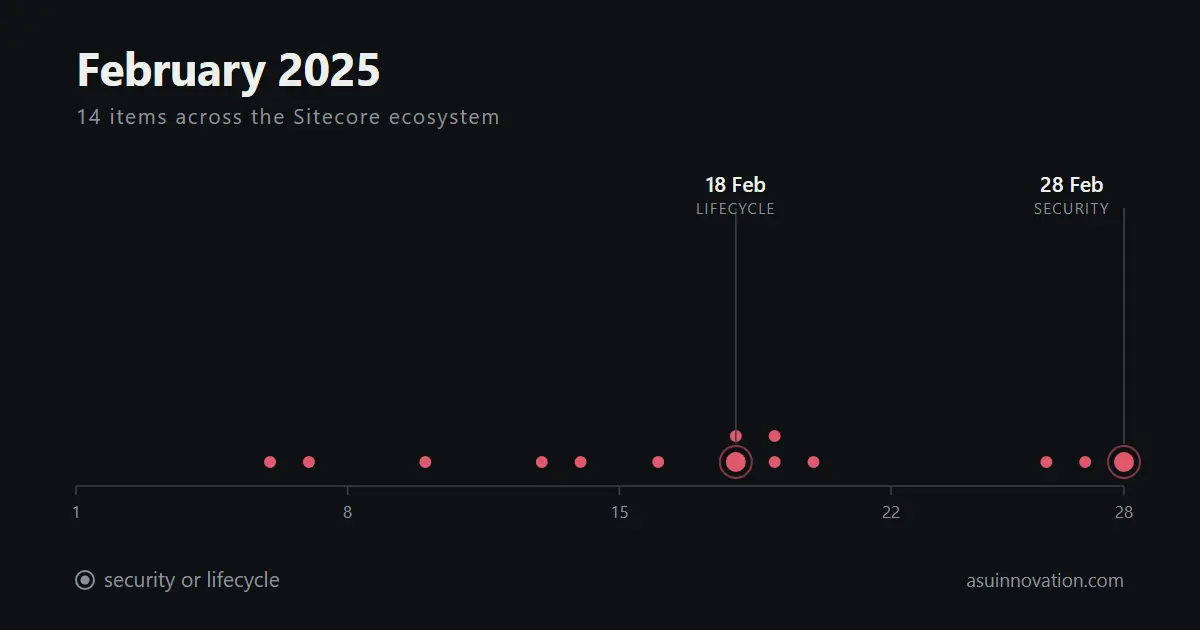
In February 2025 the thing that changed a decision was field editing inside Pages. Droplists, multilists, treelists, checkboxes, file fields, page metadata that never appears on the page: all of it became editable in the XM Cloud page builder, and the last honest technical argument for keeping Experience Editor went away.
Everything else the month produced reads as the invoice for that move. Fourteen posts from people who run the platform, and most of them are about a seam you only find after you have migrated: media URLs that expire mid-cache, an upgrade that breaks contact search, a Solr default that asks for a million documents per query, and a vulnerability whose severity went up while staying out of the security bulletin.
Pages can now edit the fields that used to send you to the Content Editor
XM Cloud Page Builder Achieves Feature Parity with Experience Editor — MG on SC. The page carries no byline; the blog is Marcel Gruber's and the post signs off "-MG". Ten field types moved into the page builder's content panes. The write-up ties the change to Sitecore's February seasonal release and links the XM Cloud changelog entry of 19 February, and its verdict, "Pages has reached near-complete feature parity with Experience Editor", matches that list. The other claim in the post, that Experience Editor is "estimated to be sunset in Q2 this year", is the author's estimate and not a published lifecycle date. Do not put it in a migration plan without confirming it with Sitecore.
A CVE that is not in the bulletin, and what support said about it
Sitecore Security: Are These 2023 CVEs Still a Risk? — Gabe Streza, who works at Genpact Experience and implements Sitecore commercially The three 2023 PageDesigner vulnerabilities, two directory traversals and one deserialization issue, had their severity raised in late January 2025. Streza asked Sitecore Support whether they were covered by bulletin SC2024-001-619349 and reports being told that CVE-2023-27067 is not, because exploitation requires an authenticated user: in his words, Sitecore "does not consider it critical enough to be included in an official security bulletin". The mitigation he passes on for anyone below 10.3 is deleting a single deprecated PageDesigner file.
This is one person relaying a support conversation, not a published advisory, and severity plus applicability are exactly the claims that need a vendor source. Treat it as a prompt to open your own ticket, not as clearance. It is also the most useful thing anyone published about Sitecore security that month, which says something about how the bulletin process reads from outside.
Your XM Cloud image URLs expire in ten minutes
Sitecore Media Query Parameters You Did Not Know About! — Anton Tishchenko. Our harvest recorded no author for this page; that record was wrong, the article is bylined.
This starts with images that worked locally, stopped, and came back after a container restart.
The cause was two undocumented query parameters, ttc and tt: a timestamp and a hash over
the path, the query and a shared secret. Media URLs are signed and expire, ten minutes by default, and after
that you get a 302 instead of an image. Tishchenko went to ILSpy to find this, checked
Sitecore.Kernel version 41, and reports the parameters are "valid only for SitecoreAI (XM
Cloud)", absent from 10.4 XM and XP and from Experience Edge.
The consequence is specific and expensive: if you build with Next.js in SSG or ISR, your static
HTML holds image URLs that die before the cache does, and no build pipeline knows about it.
Aligning Media.UrlSignatureExpirationTimeout with your revalidation window makes it rare
rather than absent. It is reverse-engineered behaviour on an undocumented feature, so verify it
against your own instance before changing a setting on the strength of it.
The upgrade and infrastructure bill
Sitecore Error Troubleshooting: Experience profile search issue (Upgrade from sitecore 10.1 to 10.4) — Chandan, chandan-sitecore.blogspot.com
A 10.1 to 10.4 upgrade, and the Experience Profile search returns a Solr 400 with undefined field textmatch. The post shows the actual xConnect stack trace, which is what makes it worth
bookmarking: this failure is invisible until a marketer opens Experience Profile and finds
contact search broken, usually weeks after sign-off.
Sitecore SearchStax SOLR High CPU Usages — Himmat Singh Dulawat
Sitecore ships ContentSearch.SearchMaxResults at 1,000,000, so Solr reserves memory for a
million documents on every query, and Sitecore issues hundreds of them per second. The
recommendation relayed here is to drop it to 100 unless you have a real reason, plus a longer
MaximumCommitMilliseconds and index rebuild intervals of 20 and 10 minutes. If you are paying
for a managed Solr and wondering why the CPU graph is flat at the top, start here.
XM to XM Cloud Migration tool - 2.1 - Overview of Application Configuration — Nehemiah Jeyakumar, Nehemiah Blog
The appsettings.json the migration tool writes on first run, field by field, including the
batch controls: 10,000 items per RAIF and a 100 MB media cap. Dry, and the kind of thing you
want in front of you the first time a transfer stalls.
How to Run Sitecore 10.3.x in Docker on Windows 10 — MG on SC. Again no byline on the page.
Mostly a working docker-compose for XP 10.3 on Windows 10. Worth noting only because it is
February 2025 and people are still standing up local XP containers, which is the honest
counterweight to every post above about moving to the cloud.
Search and personalisation: three answers to the same question
Sitecore Personalization Deep Dive: SitecoreAI vs XP vs Personalize — Theresa Gutierrez, Fishtank Consulting, who implement Sitecore commercially A comparison table across hosting, edge delivery, omnichannel, AI decisioning and how much developer time each option actually needs. The useful part is not the table, it is the admission underneath it: after taking the CDP and Personalize training, "much of the setup felt geared toward developers". Anyone selling Personalize to a marketing team as a self-service tool should read that line twice.
Enhancing Product Discovery: Implementing Semantic Search with OrderCloud and Azure AI Search — Subramanian Ramanathan Vector embeddings from Azure OpenAI, an Azure AI Search index, a Logic App on an OrderCloud webhook. It works, and it is also a straightforward admission that in February 2025 you had to leave the Sitecore stack to get semantic product search. The post notes that fuller semantic capability sits on Sitecore Search's roadmap, which is his reading of the changelog rather than a commitment you can hold anyone to.
COVEO : CHOOSE THE RIGHT LIBRARY Coveo Atomic or Coveo Headless For XM-CLOUD/ Sitecore — varasitecore, V-In Sitecore Atomic for a standard search page, Headless when the design has a carousel in the results. The decision usually gets made by whoever writes the first component, and it is expensive to reverse, so having it written down in one screen is worth more than the post's length suggests.
Sitecore XM Cloud & Content Hub for Content Velocity in 2025 — Ketan Sethi The strategic case for atomic content and structured metadata across XM Cloud and Content Hub, written in the register of a slide deck and with no implementation detail in it. The argument that metadata is what makes content machine-readable has held up better than most of what was written about AI in early 2025.
The rendering host argument that was not happening in public
Sitecore ASP.NET SDK and interactive components — Jesper Balle The ASP.NET Core SDK was relaunched as open source, and Balle makes the case for using it as the rendering host instead of Next.js: a stack your .NET team already has, full page loads with fewer surprises, and a runtime he argues is simply quicker. "It is a faster runtime. Yes, .Net is faster than node." Then the interesting half, which is what you do about interactivity: an islands architecture with Preact rather than React, on the numbers he measured, 15 KB against 555 KB for an empty app and 77 KB against 602 KB once a carousel package is in.
Those are his measurements on his build, not a benchmark, so take the shape of the argument rather than the figures. It is the only February piece that questions the default choice of a Node rendering host, and that question deserved more company than it got.
Two smaller ones
Prevent Item Saving When a Sitecore Field is Required — thebitsthatbyte.com. Our record captured a form label instead of a byline, so we cannot name the author from what we harvested. A required field in Sitecore warns and then lets the author save anyway. This walks through the four validation surfaces and raising the rule to a hard stop. Governance that only warns is governance that gets ignored.
A conversation with AI — Dean O'Brien, who works at Northumbria University. The harvest recorded only his first name. He asked ChatGPT how generative AI might drive personalisation behind a Sitecore site, and it recommended a GitHub repository that turned out to be his own. Light, and he tells it against himself, which is more than most AI posts manage.
What February 2025 actually told us
Read the fourteen together and the same fact keeps surfacing: the operational knowledge of a
managed product is being produced by its customers, with a decompiler. The ttc and tt
parameters are undocumented, exist only in the cloud product, break a mainstream Next.js
rendering pattern, and were found by one developer opening ILSpy after images went missing
locally. The CVE answer came out of a support ticket someone else opened.
On-premise that trade was tolerable, because you controlled the version and could pin it. In a continuously updated SaaS you cannot, so undocumented behaviour stops being a curiosity you work around once and becomes a moving dependency in your build. Feature parity in Pages is a real reason to move, the seams above are the real cost of moving, and February 2025 is the month both arrived together.
One more thing that only shows up reading a month in one sitting: these authors were already using "SitecoreAI" and "XM Cloud" in the same sentence for the same product. When the people writing the field documentation are hedging on the product's name, expect to spend part of your next project explaining to a client what they bought.
We reached February 2025 through feed archives rather than live, so this is what survived in the feeds, not everything published that month. Thirty-one Sitecore items cleared the scope filter and fourteen are cited here.
Sources
- XM Cloud Page Builder Achieves Feature Parity with Experience Editor — no byline on the page, MG on SC
- Sitecore Security: Are These 2023 CVEs Still a Risk? — Gabe Streza, Genpact Experience
- Enhancing Product Discovery: Implementing Semantic Search with OrderCloud and Azure AI Search — Subramanian Ramanathan
- Sitecore Personalization Deep Dive: SitecoreAI vs XP vs Personalize — Theresa Gutierrez, Fishtank Consulting
- Sitecore ASP.NET SDK and interactive components — Jesper Balle
- How to Run Sitecore 10.3.x in Docker on Windows 10 — no byline on the page, MG on SC
- Sitecore Media Query Parameters You Did Not Know About! — Anton Tishchenko
- COVEO : CHOOSE THE RIGHT LIBRARY Coveo Atomic or Coveo Headless For XM-CLOUD/ Sitecore — varasitecore, V-In Sitecore
- Sitecore XM Cloud & Content Hub for Content Velocity in 2025 — Ketan Sethi
- Sitecore SearchStax SOLR High CPU Usages — Himmat Singh Dulawat
- A conversation with AI — Dean O'Brien
- Sitecore Error Troubleshooting: Experience profile search issue (Upgrade from sitecore 10.1 to 10.4) — Chandan
- XM to XM Cloud Migration tool - 2.1 - Overview of Application Configuration — Nehemiah Jeyakumar, Nehemiah Blog
- Prevent Item Saving When a Sitecore Field is Required — no usable byline captured, thebitsthatbyte.com