
January 2026: Sitecore renamed the platform and left the community to document it
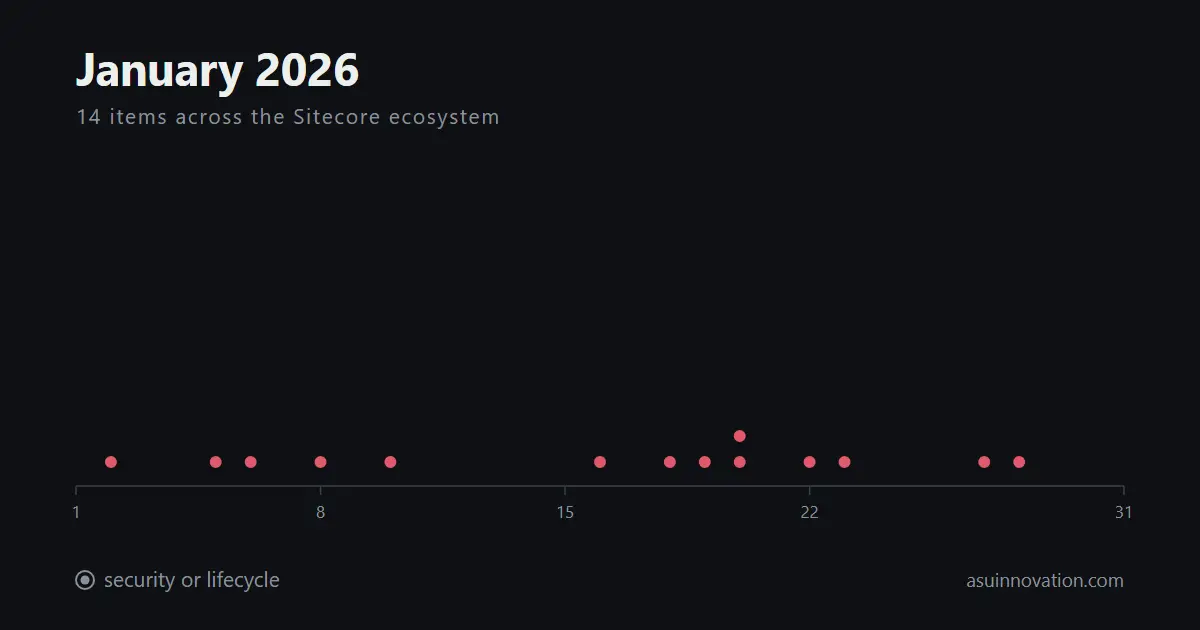
Thirteen Sitecore items cleared our bar in January 2026 and not one of them came from sitecore.com. Everything you could read that month about how SitecoreAI actually behaves was written by a partner agency or by somebody with a personal blog and an evening free.
That matters more than it would in a quiet month, because several of the things being documented are previews. A preview feature explained by a third party is a thing you can learn about but cannot plan around, and January produced a lot of the first and none of the second.
SitecoreAI is being documented by everybody except Sitecore
Separate editing hosts in SitecoreAI — Jesper Balle, on his own blog Splitting the authoring platform from the editing host means the head application can live in its own repository with its own pipeline, which is the difference between one team's deploy breaking one thing and breaking two. Balle walks the Deploy UI path and then the CLI path, because the UI makes repository and branch mandatory and the CLI does not. He is explicit that the separation is currently a preview feature you switch on. We have no vendor-official source for its status or its timeline, so treat this as one practitioner's report from the preview and confirm with Sitecore before you put it in an architecture document.
Agentic Studio Explained — Theresa Gutierrez, Fishtank Consulting Fishtank implement Sitecore commercially, so read the framing accordingly. That said, this is the most complete description available of what Agentic Studio is meant to do: a governed workspace for long-running agent workflows rather than, in Gutierrez's own list of exclusions, "a chatbot builder" or "a generic AI assistant bolted onto the UI". If you have been asked what Sitecore means by agentic and you have only the marketing page, this fills the gap. It should not have to.
Getting Started with Sitecore Content SDK, Next.js App Router & shadcn/ui — Sohrab Saboori, Fishtank Consulting The Content SDK succeeds JSS, and this is a full scaffold-to-component walkthrough on Next.js 15 with the App Router. The line to read twice is the beta notice: the App Router template is in beta and, in Saboori's words, "the Pages Router template remains the stable option for production deployments". Same caveat as above on the source being a Sitecore implementation partner, and same caveat on status claims that no vendor page confirms. If you are starting a build this quarter, the interesting question is not whether App Router works, it is whether you want your rendering host on a beta template for the next eighteen months.
Shipping Custom Fields is Trivial as of 2026 — no byline on the page; the site is Marcel Gruber's Sitecore blog
Our harvest recorded no author for this one, and the page itself credits nobody, so we are not
putting a name on it beyond the site's own description. The content is the most concretely
useful thing in the SitecoreAI half of the month: there is a new Plugin field type that stores
arbitrary JSON, you build a small app to edit that JSON, host it, register it in the
Marketplace and point the field's Source at it. The author started from Sitecore's
marketplace-icon-picker repo and had a repeater grid field running in under thirty minutes.
Whatever you think of the thirty-minute claim, the shape of the extensibility model is now
clear, and it is a much shorter path than a custom field in XP ever was.
The stack most of us still run is where the actual numbers are
Sitecore 10.4 Stress Testing Results Across Environments — Jose, on Sitecore Tips; the page gives no surname The only hard numbers published all month, and they are about the version nobody is writing conference talks about. A non-scaled QA box with every role on one server held around 350 concurrent users, degraded past 400 and became unusable beyond 500. A scaled UAT environment with 128 GB of RAM and a single CD server held 600, started degrading around 750, and returned errors at 1,000. This is one person's corporate site on one topology, not a vendor benchmark, so do not paste it into a capacity plan. Do use it the next time somebody asks whether one CD server is enough: it gives you a shape to argue from instead of a shrug.
Edge Publishing in Sitecore Explained — Khushboo Sorthiya, Sitecore Corner Originally written for the Sitecore Advent Calendar 2025 and republished here. It traces publishing from the CM-to-CD database model through to pushing content, layout and media into Experience Edge, and it explains the V1 to V2 change rather than just naming it. Most "why is my content not on the site" tickets are really a misunderstanding of where Edge sits in that chain. Hand this to whoever is on support next week.
SITECORE Experience Editor Pitfalls & How to Fix Them — Vishal Khera (our harvest mangled the byline into a string of MVP titles; the author is Vishal Khera) Khera calls Experience Editor "one of the most fragile areas of a Sitecore solution", which is the honest version of a feature usually sold as the reason to buy. The failure modes are the familiar ones: renderings that assume they will never run in EE, external API calls in the render path, Scriban and Razor that manipulates markup until inline editing stops working. The fix he keeps returning to is to check for EE mode and do less in it. Cheap to apply, and it prevents the class of bug a developer can never reproduce because they never open the editor the way an author does.
How to Set Up Sitecore Search Using the Sitecore Cloud SDK in Next.js — Manoj Chopkar, Sitecore help house The prerequisites are the point. Search is a separate SaaS product, it is not switched on with XM Cloud, and you need it provisioned and linked to the organisation before any of the SDK code does anything. Chopkar also flags that you may need a support case so your Context ID carries the Search resource. That is exactly the sort of detail that turns a two-day integration into a two-week one when you find it at the end instead of the beginning.
The arguments, and the thing underneath
What Teams Must Unlearn From the Composable Era — David Goosem, on his own blog The best-written piece of the month. Goosem's claim is that agentic platforms need context density, and that a decade of decomposing everything into micro-pieces produced exactly the opposite: "In the composable era, decoupling was a strength. In the AI era, coherence is the strength." You can push back on that. Coherence has historically been the argument for the monolith you spent five years escaping, and "AI needs it" is not yet a measurement. But it is a real argument with a real shape, which puts it ahead of most opinion writing about DXP.
Exploring Sitecore's Blok Design System — David Austin, Fishtank Consulting Fishtank again, same commercial relationship to the product. A long tour of Sitecore's own design system, which matters mainly if you are building backoffice extensions or Marketplace apps and want them to look native rather than bolted on. Given the Marketplace path described above, that audience just got bigger.
AI Adoption vs. AI Impact — Theresa Gutierrez, Fishtank Consulting Strategy rather than engineering, and the numbers are McKinsey's rather than Fishtank's: Gutierrez cites 88% of organisations using AI somewhere against 39% reporting measurable EBIT impact. Useful if you are the person who has to answer why the AI pilot has not moved anything yet. Worth noting that four of the thirteen items here come from Fishtank, an agency that sells Sitecore implementation. They are writing the documentation nobody else is writing, and they are also the people you would hire to build the thing they are describing.
Foundry IQ – Agentic retrieval solution, part 1 — credited to the site handle 360Agileweb rather than a person Azure AI Search plus Microsoft Foundry for retrieval-augmented generation, with the knowledge base separated from the agent logic so several agents can share one. Not a Sitecore feature, but it is the pattern sitting behind the agentic vocabulary everyone is now using, and it is the part you would actually have to build.
The Grand Mystery of the Missing 18 Bytes — Steve Gordon, Code with Steve An 18-byte discrepancy between BenchmarkDotNet and a memory profiler, chased to the end instead of shrugged at. Sitecore is ASP.NET Core underneath and Gordon is the best explainer of what that runtime is really doing. Read it for the method rather than the answer.
What we're watching
The uncomfortable read of January is not that Sitecore was quiet. It is that a platform was renamed and re-pitched around agents while the only usable explanations of it came from an implementation partner and three personal blogs. Preview features, beta templates and a new extensibility model, all described by people with no obligation to keep the description accurate next month.
We would not start a client build on the App Router template or the separated editing host this quarter on the strength of what exists in writing. Not because the reporting looks wrong, but because none of it is a commitment anyone owes you. Meanwhile the one document from January with numbers in it is about 10.4, which is where most of the actual Sitecore estate still lives, and which nobody is being paid to write about.
Sources
- Separate editing hosts in SitecoreAI - use Sitecore CLI for extended options — Jesper Balle
- Agentic Studio Explained: How SitecoreAI Turns AI Into Execution — Theresa Gutierrez, Fishtank Consulting
- Getting Started with Sitecore Content SDK, Next.js App Router & shadcn/ui — Sohrab Saboori, Fishtank Consulting
- Shipping Custom Fields is Trivial as of 2026 — no author credited on the page (MG on SC)
- Sitecore 10.4 Stress Testing Results Across Environments — Jose, Sitecore Tips
- Edge Publishing in Sitecore Explained: What, How, and Why — Khushboo Sorthiya, Sitecore Corner
- SITECORE Experience Editor Pitfalls & How to Fix Them — Vishal Khera, Insights with Vishal Khera
- How to Set Up Sitecore Search Using the Sitecore Cloud SDK in Next.js — Manoj Chopkar, Sitecore help house
- What Teams Must Unlearn From the Composable Era — David Goosem
- Exploring Sitecore's Blok Design System — David Austin, Fishtank Consulting
- AI Adoption vs. AI Impact: Why Organizations Fail to Scale — Theresa Gutierrez, Fishtank Consulting
- Foundry IQ – Agentic retrieval solution – part 1 — credited to 360Agileweb, no individual named
- The Grand Mystery of the Missing 18 Bytes — Steve Gordon, Code with Steve