
March 2026: Sitecore put a price on standing still
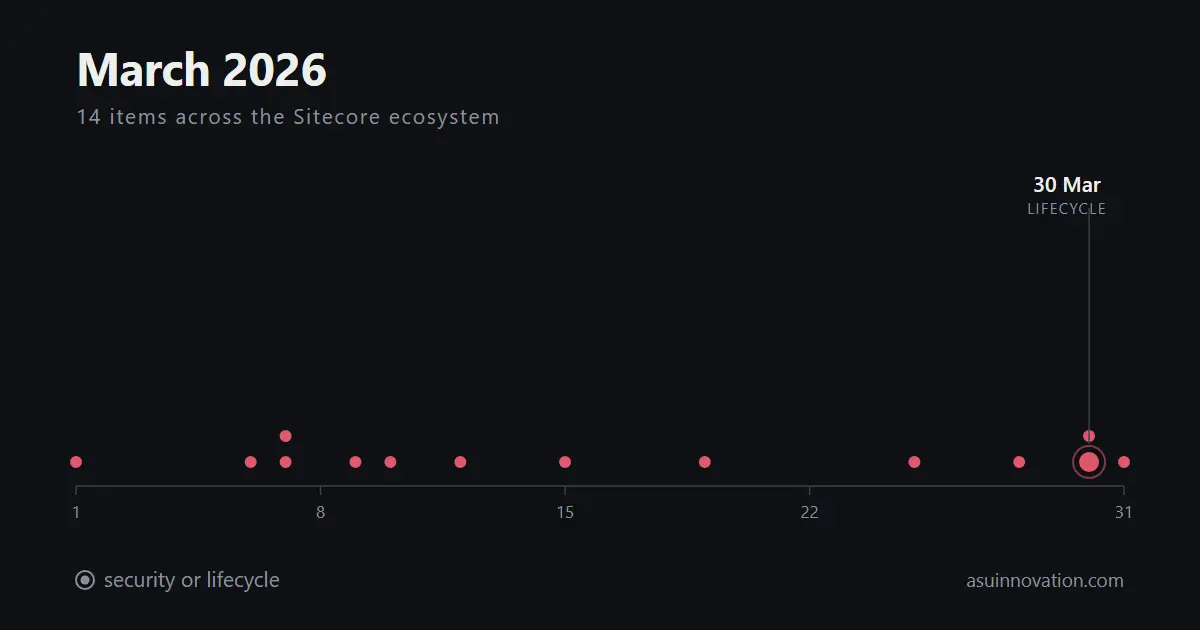
If you are running Sitecore 9.x, 10.0 or 10.1, March 2026 is the month your upgrade stopped being a planning exercise. The support model changes on 1 June, and the part that changes is the part you were relying on: security updates and production incident support stop being included in Extended Support and become a paid conversation with your account representative.
That claim reaches us through Sitecore 2026 Support Changes: Version Breakdown — Dan Cruickshank, Fishtank Consulting, who reads Sitecore's own KB0641167 and lays the before and after side by side. Fishtank implement and upgrade Sitecore commercially, they sell an accelerator for exactly this migration, and the post closes with a contact form. None of that makes the dates wrong, and Cruickshank is specific where a marketing post would be vague: "From June 1, 2026, both of those move to paid as well." But this is a lifecycle and pricing claim sourced to a partner rather than to Sitecore, so read KB0641167 yourself before you take a number into a budget meeting.
What the dates actually say
9.0 is past End of Life. 9.1 through 9.3 sit in Sustaining, where security patches are not available at any price, which means the support conversation for those instances is over and the remaining conversation is about migration. 10.0 and 10.1 are the pressing case: Extended Support ends 31 December 2026, and after that they drop into the same Sustaining hole. 10.2 runs to the end of 2027, 10.3 to the end of 2028, and 10.4 is the only version still in Mainstream.
The practical consequence is narrower than "upgrade soon". For nine months, a 10.0 instance can still buy a security patch. After that it cannot. If your compliance posture assumes patch availability, the assumption expires on a date you can put in a calendar.
Content SDK 2.0 wants Next.js 16, and renames the file your redirects live in
The other cost landed at the end of the month. Content SDK 2.0 – Next.js upgrade and breaking
changes
— Praveen Singh Panwar, writing on his own blog, walks the upgrade from 1.5.1 and names the
breaks: middleware.ts is replaced by proxy.ts, the middleware folder survives but only for
robots and sitemap handlers, images.domains is deprecated in favour of remotePatterns, and
the core package is split from @sitecore-content-sdk/content. The floor is now Next.js 16.
His verdict on the timing is the honest part: "That's definitely a bummer if you recently did this upgrade." Teams that moved onto Content SDK 1.5.x in the last two quarters are doing the work again. This is a breaking-change claim from a community source; he links Sitecore's changelog and the official 1.5.1 → 2.0 upgrade page, and those are what you should follow when you plan the work.
The AI surface shipped and the manual for it is being crowdsourced
Sitecore Marketer MCP a deep dive - Available tools and fields details - Part
1
— Nelson, Sitecore getting started to advanced is the piece to read before anyone in your
organisation connects an agent to a Sitecore instance. He enumerates all 42 tools with their
parameters, and the list is not read-only: create_page, add_component_on_page,
delete_content, create_personalization_version. An agent holding those tools is an
authorisation design problem before it is a productivity story, and nobody publishing about MCP
this month treated it as one.
Alongside it, Understanding Sitecore Marketplace Extension Points — Devanshi, Tech Insights By Devanshi covers the five places a Marketplace app can appear: Standalone in the Cloud Portal, Full Screen, Page Context inside the editor, Dashboard Widget, and Custom Field. It is short and it cites Sitecore's documentation, and it answers the decision you make before writing any code, because the extension point determines what context the app receives.
Sitecore in the Age of AI Agents: Is Your DXP Ready for Agent-Mediated Discovery? — Rachna Gupta is the month's argument piece rather than its reporting. We do not know what commercial relationship, if any, sits behind it, so read it as a position and not as neutral analysis. The position is worth the time: if the primary reader of your content becomes an agent, schema discipline outranks your component library, and where the model is ambiguous "agents will hallucinate the 'missing' structure". Anyone who has watched a retrieval system invent a product attribute will recognise the failure mode.
Two hackathon write-ups were the most honest AI reporting of the month
I Created Sitecore PowerShell Extensions in One Day! carries no byline: the harvest records the outlet as Anton Tishchenko's exdst.com, and nothing on the page credits an author by name. The post describes entering Sitecore Hackathon 2026 alone, or nearly: "My team this year: me and two instances of Claude Code." The output was a Marketplace app rebuilding Sitecore PowerShell Extensions in JavaScript over the Authoring and Management GraphQL API, and the write up is unusually specific about the bad decisions as well as the good ones.
#Sitecore Hackathon 2026 : 24 Hours of Adventures — credited only to the handle sitecorerunner (@reilleyweb), on the site Sitecore Runner — is the same experiment from the other side, hour by hour, ending on a Page Context panel that generates SEO and accessibility suggestions. His line, "No AI is not replacing developers", sits next to an admission that he used it as the teammate he did not have.
Read together, they say something the vendor material does not. The people learning Sitecore's new extension model first are learning it in 24-hour sprints, and publishing what they found before Sitecore's own guidance catches up.
The plumbing that still breaks
How to Fix Images Not Loading on First Page Load in Next.js with Sitecore XM
Cloud
— Manoj Chopkar, Sitecore help house is the highest-value debugging save here. Preview media
URLs carry tt and ttc signature parameters that expire after ten minutes, governed by
Media.UrlSignatureExpirationTimeout. Statically generated HTML keeps the stale URL, the browser
gets a 403, and a refresh appears to fix it. Production over Experience Edge is unaffected, which
is exactly why the bug survives so long in preview.
Installing Coveo for Sitecore in Docker Containers — Zaheer Tariq, Sitecore Tech Blog is a 10.4.1 upgrade story that ran into an undocumented build: the only community repository he found was unmaintained, and he says Coveo "does not have clear/straightforward documentation on how to do it". He published the fixes, which is more than either vendor did.
Two from Fishtank, who as noted sell Sitecore implementation work. Add Last Updated Timestamp
in Sitecore with Next.js
— Roberto Barbedo gets the __Updated system field out through GraphQL, since the Layout
Service does not return it; useful mainly as a way to confirm from the front end that a publish
actually landed. Processing Sitecore webhooks with
Trigger.dev
— Roberto Barbedo again, moving webhook work off a serverless function that times out, and
adding the step most teams miss: waiting until the published item is genuinely visible on the
delivery layer before doing anything with it.
Indexing External REST API JSON directly into Sitecore
Search —
Chirag Goel, Coders Lifeline covers API crawlers, and leads with the mistake rather than the
recipe: dumping a whole JSON payload into the index costs relevance and query time, and
attributes have to exist before ingestion or the data silently does not land. Building a CSV
Import System for SitecoreAI
— John Flores, Fishtank Consulting builds the editor-facing importer over the Authoring GraphQL
API, with the detail that saves an afternoon: the parent argument takes a GUID, not a path.
Finally, Sitecore Content Hub Developer Certification – Preparation Guide — Vishal Khera, whose byline our harvest mangled into "3× Sitecore MVP & DX MVPVISHAL KHERA", frames the exam as scenario-based: "This is not a mug-up exam."
What we would do about it
Four of the fourteen items here come from one consultancy, Fishtank, which is a fair share of the month's Sitecore writing arriving from a single commercial voice.
The thing worth arguing about is the sequencing. Sitecore has attached a price to standing still, effective 1 June, in the same quarter that the SDK for its destination platform broke the upgrade path of the people who already moved. Both decisions are defensible on their own. Together they ask teams to commit budget to a target whose surface changed twice in fifteen months.
So we would treat the June date as a budget trigger and the destination as provisional. If you are on 10.0 or 10.1, start the conversation now, because nine months disappears into procurement faster than anyone plans for. If you are already on Content SDK, plan for the next breaking release rather than pretending 2.0 is the settled state. And if you are wiring an agent into a Sitecore instance because the Marketer MCP makes it easy, read Nelson's tool list first and decide which of those 42 tools an agent should be allowed to call in production. The answer is not all of them.
Sources
- Sitecore 2026 Support Changes: Version Breakdown — Dan Cruickshank, Fishtank Consulting
- Content SDK 2.0 – Next.js upgrade and breaking changes — Praveen Singh Panwar
- Sitecore Marketer MCP a deep dive - Available tools and fields details - Part 1 — Nelson, Sitecore getting started to advanced
- Understanding Sitecore Marketplace Extension Points — Devanshi, Tech Insights By Devanshi
- Sitecore in the Age of AI Agents: Is Your DXP Ready for Agent-Mediated Discovery? — Rachna Gupta
- I Created Sitecore PowerShell Extensions in One Day! — no byline on the page; outlet recorded as Anton Tishchenko
- #Sitecore Hackathon 2026 : 24 Hours of Adventures — sitecorerunner (@reilleyweb), Sitecore Runner
- How to Fix Images Not Loading on First Page Load in Next.js with Sitecore XM Cloud — Manoj Chopkar, Sitecore help house
- Installing Coveo for Sitecore in Docker Containers – Generating Sitecore docker image with Coveo for Sitecore Installed — Zaheer Tariq, Sitecore Tech Blog
- Add Last Updated Timestamp in Sitecore with Next.js — Roberto Barbedo, Fishtank Consulting
- Processing Sitecore webhooks with Trigger.dev — Roberto Barbedo, Fishtank Consulting
- Indexing External REST API JSON directly into Sitecore Search — Chirag Goel, Coders Lifeline
- Building a CSV Import System for SitecoreAI — John Flores, Fishtank Consulting
- Sitecore Content Hub Developer Certification – Preparation Guide — Vishal Khera